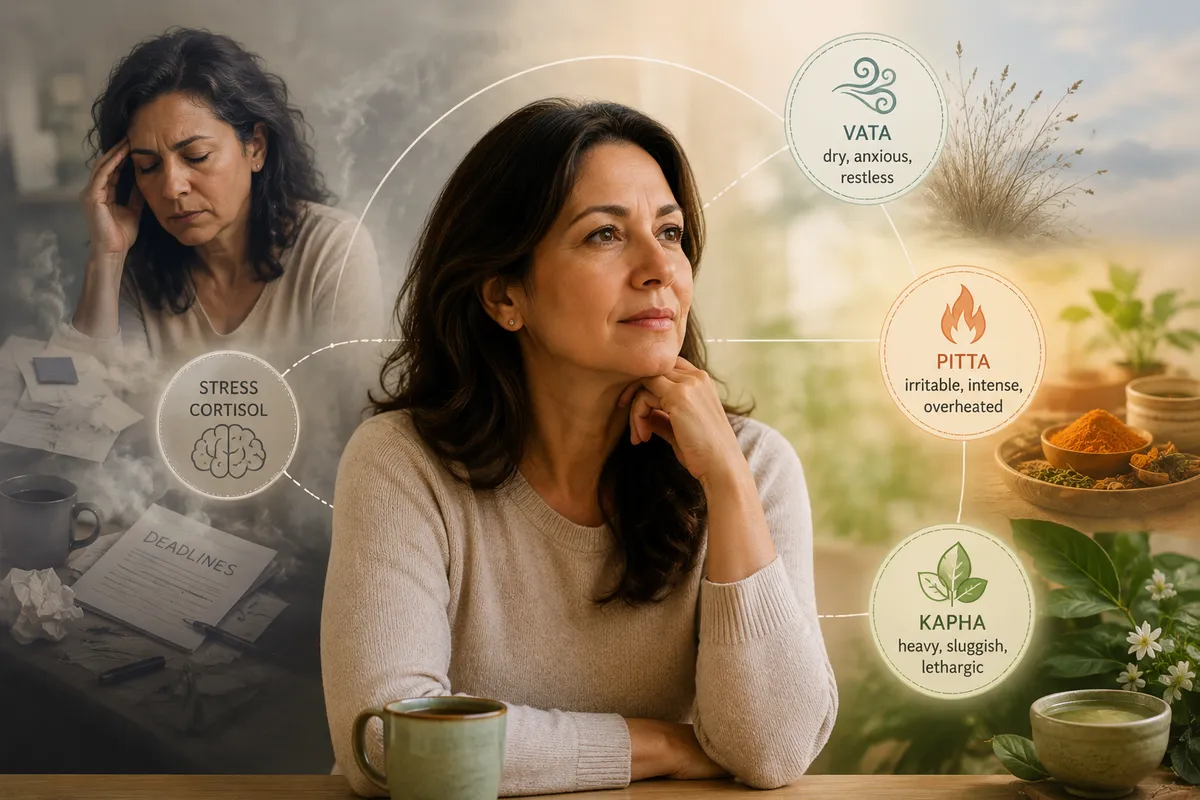
Why Perimenopause Hits Every Woman Differently: Your Dosha Type and the Stress Connection
Perimenopause has been described as everything from a minor inconvenience to a decade-long crisis. Both descriptions are accurate because the experience of perimenopause varies more dramatically between individual women than almost any other health transition.
One woman moves through her forties with minor changes to her cycle and manageable warmth at night. Another one may be navigating severe sleep disruption, cognitive fog, anxiety she has never experienced before, and weight gain that does not respond to anything that used to work in her late 30's.
These are not differences in character or attitude. They are differences in biology — specifically in constitutional type and in the stress load that lands on an individual body during the perimenopausal transition. Understanding those differences explains a great deal about why standard advice works for some women and does nothing for others, and what actually makes the difference.
What Perimenopause Actually Is
Perimenopause is the transitional phase leading to menopause typically beginning in the early to mid forties, though it can start earlier, and lasting anywhere from four to fourteen years. During this time, ovarian function shifts: ovulation becomes less regular, the corpus luteum (which produces progesterone) forms less reliably, and oestrogen levels begin their characteristic fluctuation often rising erratically before declining.
This pattern of hormonal fluctuation not the decline alone but the instability of the fluctuation is responsible for most perimenopausal symptoms. Hot flashes, night sweats, mood changes, and sleep disruption are primarily driven by oestrogen fluctuation; the loss of progesterone's calming, sleep-supporting effects compounds them.
In Ayurveda, menopause is understood as the entry into the Vata phase of life. The doshas govern not just constitution but life stages: Kapha predominates in childhood and early adulthood (growth, building, nourishment); Pitta predominates in the middle years (metabolism, transformation, productivity); Vata predominates in the later decades (movement, change, lightness, and the corresponding vulnerabilities of dryness, variability, and instability).
The perimenopausal transition is the movement from the Pitta phase toward the Vata phase — and the qualities of Vata (dryness, irregularity, cold, variability, anxiety) explain many of the most characteristic symptoms of this transition.
How Your Constitutional Type Shapes Your Perimenopausal Experience
This Vata increase in midlife interacts with whatever each woman's underlying constitution already is — and that interaction determines the flavour and severity of her perimenopausal experience.
Vata Prakriti in perimenopause enters this transition with Vata already as the dominant constitutional energy. The natural Vata increase of midlife lands on a body already inclined toward variability, dryness, and irregularity. These women often experience the most pronounced sleep disruption, the most significant anxiety and cognitive changes, the greatest difficulty maintaining weight, and the most variable symptoms — good days and bad days without obvious pattern. The dryness of Vata manifests both physically (dry skin, vaginal dryness, joint cracking) and mentally (racing thoughts, anxiety, difficulty concentrating). This constitutional type may also be more vulnerable to bone density loss, since Vata's lightness and porosity affect bone tissue under insufficient nourishment.
Pitta Prakriti in perimenopause carries fire into a transition that can amplify it. These women often experience the most intense heat symptoms — hot flashes that are genuinely uncomfortable rather than merely warm, night sweats that are drenching, and heat intolerance that feels extreme. They may also find that the perimenopausal period brings more irritability, intensity of emotion, and a kind of inner pressure or urgency that wasn't previously part of their experience. Inflammatory conditions — joint pain, skin conditions, migraines — may worsen. Because Pitta drives strong digestive capacity, these women often find that their digestion changes more noticeably than expected, with new sensitivities to foods they previously tolerated well as well as moderate to severe heartburn.
Kapha Prakriti in perimenopause enters the transition with the greatest natural stabilizing force — Kapha provides the grounding, stability, and dampening of variability that makes transitions feel less extreme. These women often report fewer and milder vasomotor symptoms (hot flashes and sweating) than Vata or Pitta types. However, the Vata increase of midlife creates an unusual experience for Kapha constitutions: their natural stability is disrupted in ways that feel disorienting precisely because disruption is unfamiliar to them. Weight gain during perimenopause tends to be more significant for Kapha types, because their already-slower metabolism meets declining oestrogen. Fluid retention, congestion, and a particular kind of emotional heaviness or withdrawal are common Kapha presentations in perimenopause.
Why Stress Changes Everything
Constitutional type explains much of the variation in perimenopausal experience, but there is a second variable that can override constitutional tendency in either direction: the stress load each woman is carrying when she enters the transition.
This is not metaphorical. The relationship between stress hormones and reproductive hormones is direct and well-documented. Cortisol the primary stress hormone, produced by the adrenal glands, is made from the same hormonal precursor as oestrogen and progesterone. Under conditions of chronic stress, the adrenal glands preferentially produce cortisol, which means less substrate is available for oestrogen and progesterone synthesis. This is sometimes called "cortisol steal" or "pregnenolone steal" — the hormonal raw material is rerouted toward stress response and away from reproductive and metabolic function.
For women entering perimenopause already carrying significant adrenal burden, years of chronic overwork, poor sleep, high-demand family situations, or the physiological stress of ongoing health issues this creates a compounding effect. The ovaries are already declining in their output; the adrenal glands are too depleted to compensate significantly; and the hormonal floor drops faster and further than it does for women whose stress load has been manageable.
The clinical picture that results is often described as "perimenopause but worse" symptoms that are more intense, more persistent, and less responsive to standard interventions than the textbook presentation. Hot flashes that occur not just at night but throughout the day; sleep disruption so profound that it drives cognitive deterioration; anxiety or emotional dysregulation that feels qualitatively different from anything experienced before.
"By the time a woman who has been running on depletion for years reaches perimenopause, her reserves are insufficient to cushion the transition and the transition does not feel cushioned, thus she may experience symptoms that are intense for both the body and the mind to handle."
In Ayurvedic terms, this pattern involves both the natural Vata increase of midlife and a specific kind of adrenal depletion described as Ojas insufficiency — the exhaustion of the vital essence that sustains resilience, immunity, and hormonal stability. Ojas is depleted by chronic overwork, inadequate sleep, excessive physical demand, emotional stress, and the long-term production of Ama rather than nourishment from incomplete digestion. By the time a woman who has been running on depletion for years reaches perimenopause, her Ojas reserves are insufficient to cushion the transition — and the transition does not feel cushioned.
What This Means for Support
The implication is that there is no single perimenopausal support protocol that works for every woman and that when standard advice produces modest results, it is usually because it was designed for a generic female body rather than for the specific constitutional type and adrenal situation of the person trying it.
For Vata types: warming, nourishing, regular, and grounding is the principle — consistent sleep and eating schedules, warm cooked foods with adequate healthy fats, practices that calm the nervous system (yin yoga, meditation, abhyanga self-massage with warm sesame oil), and herbal support that nourishes Vata and builds Ojas (ashwagandha, shatavari, warm milk with nutmeg and cardamom before bed). Regularity is medicine.
For Pitta types: cooling and downregulating is the principle — reducing alcohol, fermented and acidic foods, and excessive heat in the environment and the schedule; incorporating cooling herbs (shatavari, brahmi, amalaki); and specifically addressing the pattern of pushing through and suppressing the body's signals that characterises Pitta imbalance. Sleep and genuine rest matter as much as food choices.
For Kapha types: stimulating and lightening, while also supporting the emotional dimension of the transition — regular vigorous exercise appropriate to age and condition, warming and light foods that support metabolism, ginger and turmeric and fenugreek to stimulate the metabolic fire, and intentional attention to the Kapha tendency to withdraw or stagnate emotionally during difficult transitions.
For all types: the adrenal picture matters. If chronic stress has been part of the lead-up to perimenopause, addressing adrenal function — through targeted nutrients (B5, vitamin C, magnesium), adaptogenic herbs, sleep support, and genuinely reducing demand on the stress response — is as important as any hormonal support.
Understanding why your perimenopause feels the way it does — and what it is that your specific body needs — is not guesswork when assessed properly. It is specific and knowable.
Book a free 20-minute discovery call to talk about what a constitutional and hormonal assessment would look like for you.
Related reading:
https://www.manjirinadkarni.com/perimenopause
https://www.manjirinadkarni.com/menopause
https://www.manjirinadkarni.com/ayurveda-101
https://www.manjirinadkarni.com/weight-management