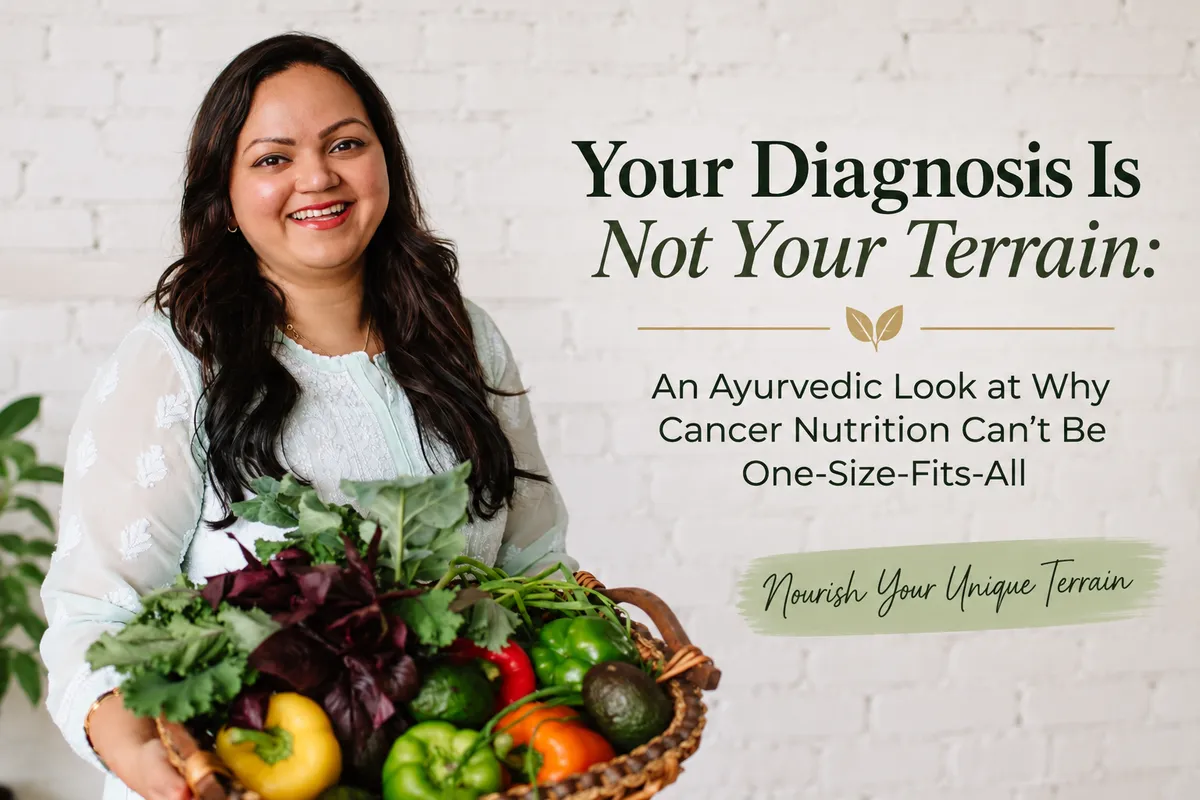
Your Diagnosis Is Not Your Terrain: An Ayurvedic Look at Why Cancer Nutrition Can't Be One-Size-Fits-All
A few months into my AIMC training, I found myself re-reading a concept I'd actually known since my earliest Ayurvedic training in India, just wearing different language: no two bodies carry disease the same way.
In Ayurveda, we call it Prakriti 'Your Inherent Constitution', the unique balance of vata, pitta, and kapha you were born with and vikriti, the state of imbalance you're in right now. In integrative oncology, the closer word is terrain: the metabolic, immune, and hormonal environment surrounding a tumor. Different vocabulary, same insight. The diagnosis on your chart is only ever half the story of what your body needs.
Two people, Two constitutions, One diagnosis
I often think of two clients I've worked with, both navigating the same type and same stage of breast cancer, both on similar chemotherapy timelines. One was a classic Pitta presentation, even before her diagnosis — sharp appetite, quick digestion, a fast metabolism, a driven nervous system that rarely idled and ran hot literally and figuratively. The other was Kapha, carrying a background load of ama (accumulated metabolic toxins) — slower digestion, a tendency toward heaviness and fatigue, congestion that lingered, a system that needed coaxing rather than calming.
Their tumors might respond similarly to treatment. Their bodies, moving through that treatment, needed almost opposite support.
"Same oncology protocol, same stage of disease. Very different nutrition conversations."
The Pitta client needed cooling, calming foods and real boundaries around rest and overexertion — her terrain was already running hot, and treatment-related inflammation only added fuel. The Kapha client needed the opposite: warming, light, easily digestible food that supported agni rather than adding further ama, along with encouragement toward gentle movement to keep her system from stagnating further. Same oncology protocol, same stage of disease. Very different nutrition conversations.
This is the piece that gets lost when cancer nutrition advice is written as a universal list of "foods to eat" and "foods to avoid." Your constitution — and the terrain it sits inside during treatment — decides which foods actually serve you.
Where Ayurveda and modern terrain science agree
I spend a fair amount of my continuing education time these days translating between two systems that, in my experience, are saying remarkably similar things in different languages:
Agni (digestive fire) and modern metabolic flexibility — both describe how well your body converts food into usable energy without excess inflammation or blood sugar swings
Ojas (vital reserve) and what integrative oncology calls physiological resilience — the reserve capacity your body draws on to tolerate treatment and repair afterward
Ama (metabolic waste/toxins) and toxic burden — the accumulated load your detoxification pathways are managing
Dosha imbalance and the individualized read of factors like inflammation, blood sugar, and stress response that make up a person's terrain
Neither system replaces oncology treatment. Both exist to answer the same question from different traditions: given everything happening in this particular body, what does it need to hold steady through treatment and rebuild afterward?
What this means for your plate
I'm not going to hand you a generic "anti-cancer food list" here, because I don't think one honestly exists. What I can offer is the questions I actually ask in a consultation, because they matter more than any single ingredient:
What does your digestion tell you? Bloating, irregularity, appetite loss, or reflux are not side issues — they're direct information about how well your body can absorb the nutrition it needs during treatment.
What's your baseline constitution, and what has treatment shifted? Someone who ran warm and fast before diagnosis often needs cooling, calming support during treatment. Someone who ran cold and slow usually needs the opposite. Treatment itself can also shift this temporarily, which is worth tracking rather than assuming.
Where is your energy actually going? Sleep quality, stress load, and nervous system state all draw from the same reserve (ojas) that your body needs for healing. Nutrition can only do so much if this reserve is being drained elsewhere.
What does your body tolerate right now, not in theory? The "healthiest" food in the world does nothing for you if it's not being digested and absorbed. This is especially true mid-treatment, when appetite and digestion often need gentler, more easily assimilated foods rather than dense or raw ones.
The point of individualized care
If there's one thing I want people to take from this, it's that feeling confused by conflicting nutrition advice during cancer treatment isn't a personal failing — it's a predictable result of generic advice being applied to a non-generic problem. Your constitution, your specific terrain, and your treatment plan together determine what actually helps, and that combination is yours alone.
This is the work I do one-on-one with clients: reading constitution alongside labs, treatment history, and daily life, and building nutrition support around the person in front of me rather than the diagnosis on the page.
🪷 Looking for personalized nutrition support during or after cancer treatment? Book an Integrative Oncology Nutrition Consultation Today!
About the Author
Manjiri Nadkarni, BAMS, MD (Ayurveda), RHN, NNCP, ONC™, is an Ayurvedic practitioner offering oncology and survivorship nutrition support, seeing clients in person in Sarnia, Ontario and virtually across Canada and internationally. She brings 15+ years of integrative clinical experience spanning India and Canada, is completing advanced integrative oncology certification (AIMC) developed by Dr. Nasha Winters, and is faculty in the Ayurveda Practitioner Program at Southern California University of Health Sciences.
This article is for general educational purposes only and does not constitute individual medical advice, diagnosis, or treatment. It is not a substitute for care from your oncology team. Please consult your physician or oncologist before making changes to your diet, supplements, or treatment plan, particularly during active cancer treatment.
References
Winters, N., & Kelley, J.J. The Metabolic Approach to Cancer. Chelsea Green Publishing, 2017.
Patwardhan, B. "Bridging Ayurveda with evidence-based scientific approaches in cancer." European Journal of Integrative Medicine, 2014.
Seyfried, T.N. "Cancer as a metabolic disease." Carcinogenesis, 2014.
Zitvogel, L., et al. "Anticancer effects of the microbiome and its products." Nature Reviews Microbiology, 2017.
Ligibel, J.A., et al. "Exercise, diet, and weight management during cancer treatment: ASCO guideline." Journal of Clinical Oncology, 2022.